Nalqevia
Luma Guide
Luma Guide
Couldn't load pickup availability
-
Problem Statement
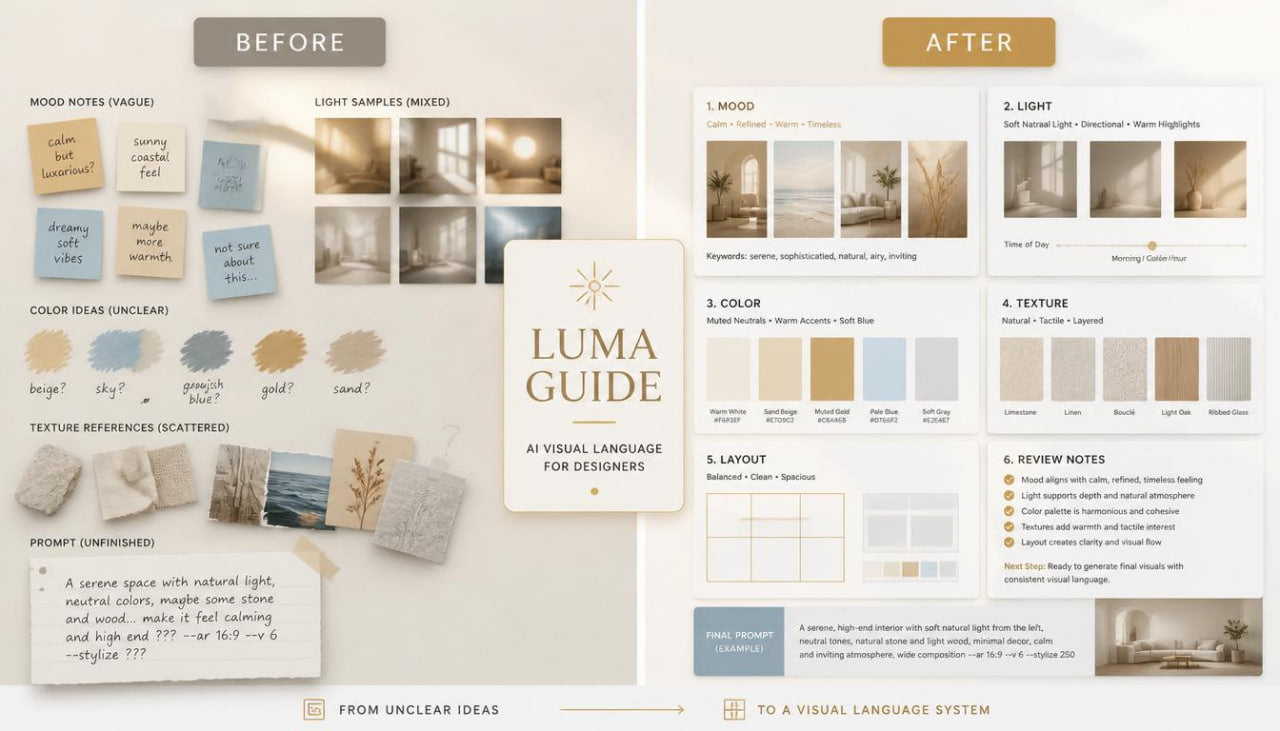
Designers often begin AI-assisted work with a strong visual sense, but without a clear written direction. A creative idea may feel vivid in the mind, yet become vague when described through prompts, notes, or briefs. This can lead to scattered outputs, repeated revisions, and a workflow that feels more confusing than useful. Many learners also struggle to connect color, mood, layout, texture, and visual references into one organized direction. Luma Guide was created for designers who want a calmer way to turn visual thinking into structured creative language. -
Solution
Luma Guide gives learners a guided path for building clearer AI-assisted design notes before moving into visual exploration. The course introduces a practical method for describing ideas through mood, subject, composition, material feel, lighting, and creative purpose. Instead of focusing on broad theory, each module uses simple examples that show how wording can shape visual direction. Learners are invited to study, compare, revise, and organize their ideas with more care. The course supports a steady creative process where AI becomes part of planning, reflection, and visual development. -
What’s Inside
Luma Guide begins with an orientation module called “Reading the Image Before Writing the Prompt.” This opening material helps learners slow down and observe how design choices work together. It explains how to look at an image through structure, contrast, rhythm, spacing, texture, and atmosphere. The goal is to help learners notice details before trying to describe them.
The next module focuses on prompt anatomy for designers. Learners study how to build a prompt from several parts: subject, visual style, mood, composition, color notes, light direction, material details, and output purpose. Each part is explained with clear examples, so the learner can see how a small wording change may affect the final visual idea.
Another section covers creative brief building. This module gives learners a simple framework for planning a visual direction before writing prompts. The brief includes space for the project idea, audience mood, visual references, color palette, shape language, and design intention. This helps learners avoid random experimentation and move with a clearer creative plan.
Luma Guide also includes a module about mood and tone. This part teaches learners how to describe visual atmosphere without relying on vague phrases. Learners study words connected to softness, contrast, editorial calm, studio lighting, abstract space, tactile surfaces, and refined minimal composition. The course shows how these words can guide a visual study with more precision.
A dedicated section explores composition language. Learners study how to describe centered layouts, layered arrangements, open negative space, close framing, object hierarchy, and directional movement. This is especially useful for designers who want AI-assisted visuals to feel more aligned with brand layouts, editorial concepts, or campaign-style studies.
The course includes guided practice tasks. One exercise asks learners to take a simple object and describe it in three visual directions: clean studio, soft editorial, and experimental abstract. Another exercise guides learners through rewriting a weak prompt into a more structured one. A third task invites learners to compare three outputs and write notes on what should be adjusted.
Luma Guide also provides a prompt refinement worksheet. This material helps learners review their own prompts by checking whether the subject, mood, color, lighting, and composition are clearly stated. It encourages learners to remove unnecessary wording, add missing details, and make the creative direction easier to understand.
The course includes a small visual critique guide. This section gives learners a method for reviewing AI-assisted visuals after they are created. It focuses on proportion, visual clarity, mood alignment, detail quality, color harmony, spacing, and overall design direction. The critique guide helps learners see revision as part of the creative process rather than a sign that something went wrong.
There is also a module on building a small personal prompt library. Learners are guided to collect useful phrases, mood descriptions, material words, and composition structures. This helps them create a reusable writing habit for future design studies. The focus is not on copying fixed formulas, but on developing a more thoughtful design vocabulary.
Luma Guide closes its learning path with a short applied mini-project. Learners create a small concept direction for a fictional design theme using a brief, a set of prompts, review notes, and a final reflection. The project is designed to connect all course parts into one creative flow: observe, plan, write, review, refine, and document.
-
Who Is This For?
Luma Guide is for designers who want a structured introduction to AI-assisted visual planning. It works well for learners who already care about design details but want clearer language for describing ideas. The course is suitable for brand designers, digital creators, layout-focused learners, creative students, and visual thinkers building a more organized study process.
It is also a strong fit for people who feel overwhelmed by scattered tutorials and want a calmer course format. Luma Guide does not ask learners to follow loud trends or copy fixed styles. It encourages observation, thoughtful writing, and creative review. The course is useful for anyone who wants to understand how prompts, briefs, and visual judgment can work together in design study.
- What You’ll Learn
- How to describe a design idea through subject, mood, light, color, and layout
- How to write clearer prompts for AI-assisted visual exploration
- How to prepare a compact creative brief before generating visuals
- How to use design vocabulary for texture, atmosphere, and composition
- How to compare several visual directions with a designer’s eye
- How to revise prompts based on what appears in the output
- How to organize useful prompt phrases into a personal study library
- How to identify unclear wording and replace it with more precise direction
- How to review proportion, spacing, contrast, and visual rhythm
- How to connect AI-assisted exploration with brand and editorial thinking
- How to complete a small creative study from brief to reflection
- How to build a steadier workflow for future course modules
-
30-Day Refund Note
Luma Guide includes a 30-day refund option under Nalqevia’s store terms. If the course does not match the learner’s study needs, a refund request may be sent through the contact page within 30 days of purchase. The request should include the order details and a short note about the reason for the request. Our team reviews each request according to the store policy and replies with the next steps.
Self-paced learning overview
- 🗂️ Digital file available after purchase
- ♾️ Long-term availability
- 🔐 Secure checkout
- 🗓️ Content updated in 2026
Do I need prior AI knowledge?
Do I need prior AI knowledge?
No prior AI knowledge is required. The materials are written with clear explanations, guided modules, and practical tasks so learners can move through the course with a calm study flow.
What do the courses include?
What do the courses include?
Each course may include modules, written materials, guided exercises, visual examples, creative prompts, and practice tasks shaped around design workflows.
Who are these courses created for?
Who are these courses created for?
They are created for designers, creative learners, brand-minded creators, visual thinkers, and anyone interested in studying how AI can support design research, concept building, and creative direction.
Share