Nalqevia
Loom Archive
Loom Archive
Couldn't load pickup availability
-
Problem Statement
Many designers collect prompts, visual ideas, mood notes, and creative references, but these materials often become difficult to use later. A strong idea may be saved in one place, a useful prompt in another, and an important review note may disappear inside an old project folder. This can make AI-assisted study feel messy, especially when a learner wants to return to a past concept or continue a visual direction. Without a clear archive, designers may repeat the same work, lose useful wording, or forget why a certain visual choice worked. Loom Archive was created for learners who want a cleaner way to collect, label, review, and reuse their creative study materials. -
Solution
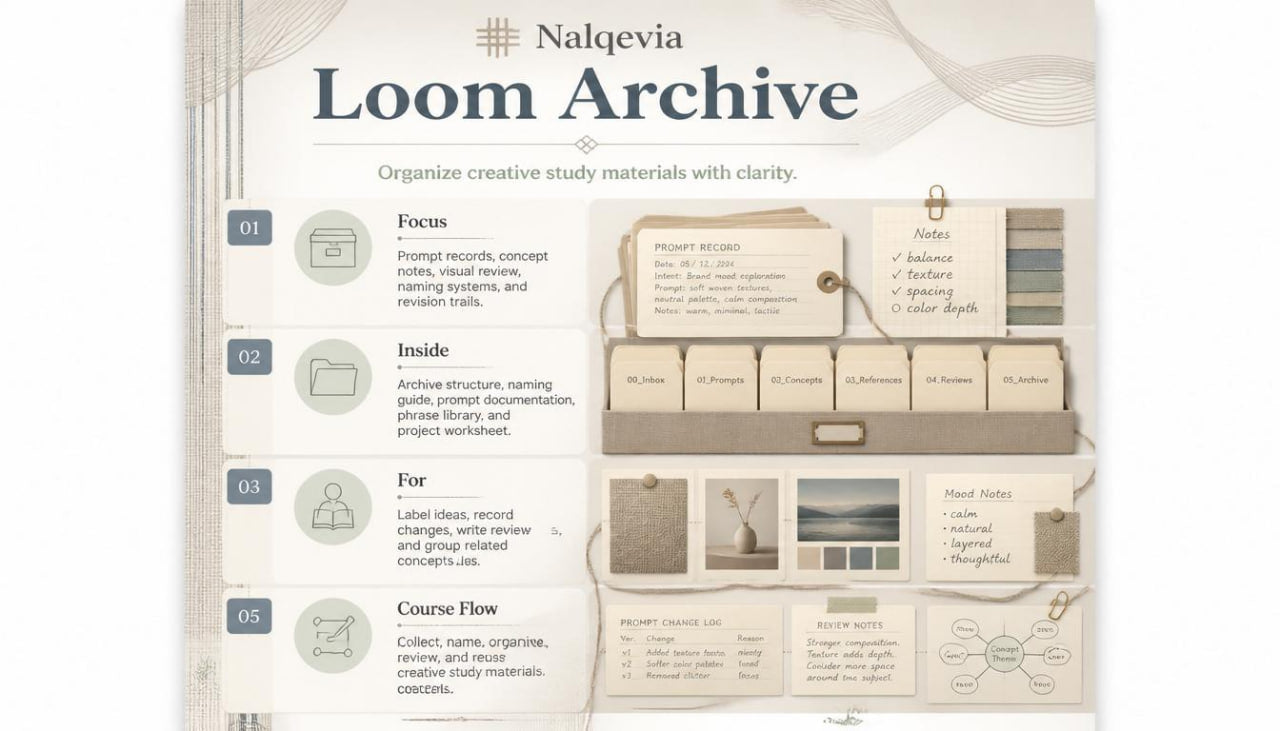
Loom Archive gives learners a structured way to build a personal design archive for AI-assisted workflows. The course shows how to organize prompt groups, mood notes, visual review comments, creative briefs, and concept variations into a clear study system. Learners explore how to name files, group ideas by theme, write useful summaries, and keep design decisions readable over time. Instead of letting materials pile up without order, this course helps learners create a practical archive that supports future creative planning. Each module focuses on clarity, organization, and thoughtful documentation for design work. -
What’s Inside
Loom Archive begins with a module called “Why Creative Notes Disappear.” This opening section looks at common habits that make design documentation hard to use later. Learners study how scattered notes, unnamed files, unclear prompt records, and missing review comments can slow down creative study. The goal is to help learners notice where their own materials become disorganized and how a clearer archive can support future work.
The next module introduces the Nalqevia archive structure. Learners study a simple method for grouping materials into creative briefs, prompt sets, visual directions, output notes, revision comments, and final reflections. Each group has a clear purpose. The brief explains the idea, the prompt set records the wording, the visual direction notes describe mood and style, and the reflection section captures what was learned from the study.
A dedicated section focuses on naming systems. Learners study how to create names for folders, prompts, visual studies, and concept branches without making the archive confusing. The course gives examples such as “soft editorial object study,” “muted ceramic layout,” “abstract light field,” or “calm brand mood direction.” These names help learners understand the content of each file before opening it.
Loom Archive also includes a module on prompt documentation. Learners are guided to record the exact wording used in a prompt, the purpose of the prompt, the visual result it created, and the changes they might make later. This helps learners build a useful prompt record rather than a random list of text fragments. The focus is on learning from each attempt and turning prompt writing into a readable study process.
Another section explores visual review notes. Learners study how to write short but useful comments about composition, lighting, material detail, color range, texture, proportion, and mood alignment. These notes help learners understand why one visual direction feels stronger than another. The course encourages learners to write in a practical design language rather than vague reactions.
The course includes an archive worksheet for creative projects. This worksheet gives learners a place to record the project title, design theme, visual mood, prompt group, output notes, revision ideas, and final study summary. It can be used for small exercises or larger creative studies. The worksheet is designed to make documentation feel lighter and more organized.
Loom Archive also includes a module on concept families. Learners study how to group related ideas under one larger theme. For example, one concept family may include soft objects, muted color studies, close-up material scenes, and spacious editorial layouts. This method helps learners keep related ideas together while still allowing variation inside the archive.
A separate section focuses on revision trails. Learners study how to record changes across several rounds of creative work. The course shows how to note what changed from one prompt to the next, why the change was made, and whether it moved the visual direction closer to the brief. This creates a clearer path through the project history.
Another part of the course covers archive review sessions. Learners are guided to return to older materials and identify what still feels useful, what needs better naming, what can be grouped with another concept, and what no longer supports the creative direction. This section helps learners maintain the archive without turning it into a storage pile.
Loom Archive also includes a module on building a prompt phrase library. Learners collect useful phrases for lighting, texture, composition, mood, subject, material quality, and visual tone. The course teaches learners to label phrases by purpose, so they can find them again when planning future work. The phrase library becomes part of the broader archive system.
The course includes a section on creative memory. This module explores how documentation can help designers remember not only what they made, but why they made it. Learners write short reflections on design intent, visual taste, repeated patterns, and personal preferences. Over time, this helps the archive become a record of creative thinking, not just a folder of materials.
Loom Archive closes with a guided archive-building project. Learners choose one previous or fictional design idea and organize it into a complete archive entry. The entry includes a concept brief, prompt group, visual notes, comparison comments, revision trail, and final reflection. This project helps learners practice the full archive method in a clear and useful way.
-
Who Is This For?
Loom Archive is for designers who want a cleaner way to organize AI-assisted creative study. It is suitable for brand designers, visual creators, design students, creative researchers, art direction learners, and anyone who works with prompts, visual concepts, mood notes, and project documentation.
This course is also useful for learners who often create strong ideas but struggle to find them later. Loom Archive helps them build a clear record of creative work, so useful materials can be reviewed and adapted for future study. It is made for people who want their AI-assisted design process to feel calmer, more readable, and better organized.
- What You’ll Learn
- How to organize AI-assisted design materials into a clear archive
- How to group creative briefs, prompt sets, visual notes, and reflections
- How to name concept files in a way that stays readable later
- How to record prompt wording with purpose and review notes
- How to write useful comments about color, texture, light, and composition
- How to build a prompt phrase library for future design study
- How to organize related ideas into concept families
- How to track revisions across several creative rounds
- How to review older materials and keep the archive clean
- How to write short reflections about design intent and visual taste
- How to create a complete archive entry for one design project
- How to turn scattered creative materials into a structured study record
-
30-Day Refund Note
Loom Archive follows Nalqevia’s 30-day refund policy. If the course does not match the learner’s study needs, a refund request may be sent through the contact page within 30 days of purchase. The request should include order details and a short note about the reason for the request. Our team reviews each request according to the store terms and replies with the next steps.
Self-paced learning overview
- 🗂️ Digital file available after purchase
- ♾️ Long-term availability
- 🔐 Secure checkout
- 🗓️ Content updated in 2026
Do I need prior AI knowledge?
Do I need prior AI knowledge?
No prior AI knowledge is required. The materials are written with clear explanations, guided modules, and practical tasks so learners can move through the course with a calm study flow.
What do the courses include?
What do the courses include?
Each course may include modules, written materials, guided exercises, visual examples, creative prompts, and practice tasks shaped around design workflows.
Who are these courses created for?
Who are these courses created for?
They are created for designers, creative learners, brand-minded creators, visual thinkers, and anyone interested in studying how AI can support design research, concept building, and creative direction.
Share