Nalqevia
Drift Framework
Drift Framework
Couldn't load pickup availability
-
Problem Statement
Many designers begin with strong creative taste, yet their AI-assisted workflow can still feel scattered. A visual idea may start with a mood, a reference, a color direction, or a shape, but without structure it can drift into unrelated results. This often happens when prompts are written one by one without a larger creative map behind them. Designers may also find it difficult to connect early exploration with a final design direction that feels visually consistent. Drift Framework was created for learners who want to move from loose experimentation into a more organized creative process. -
Solution
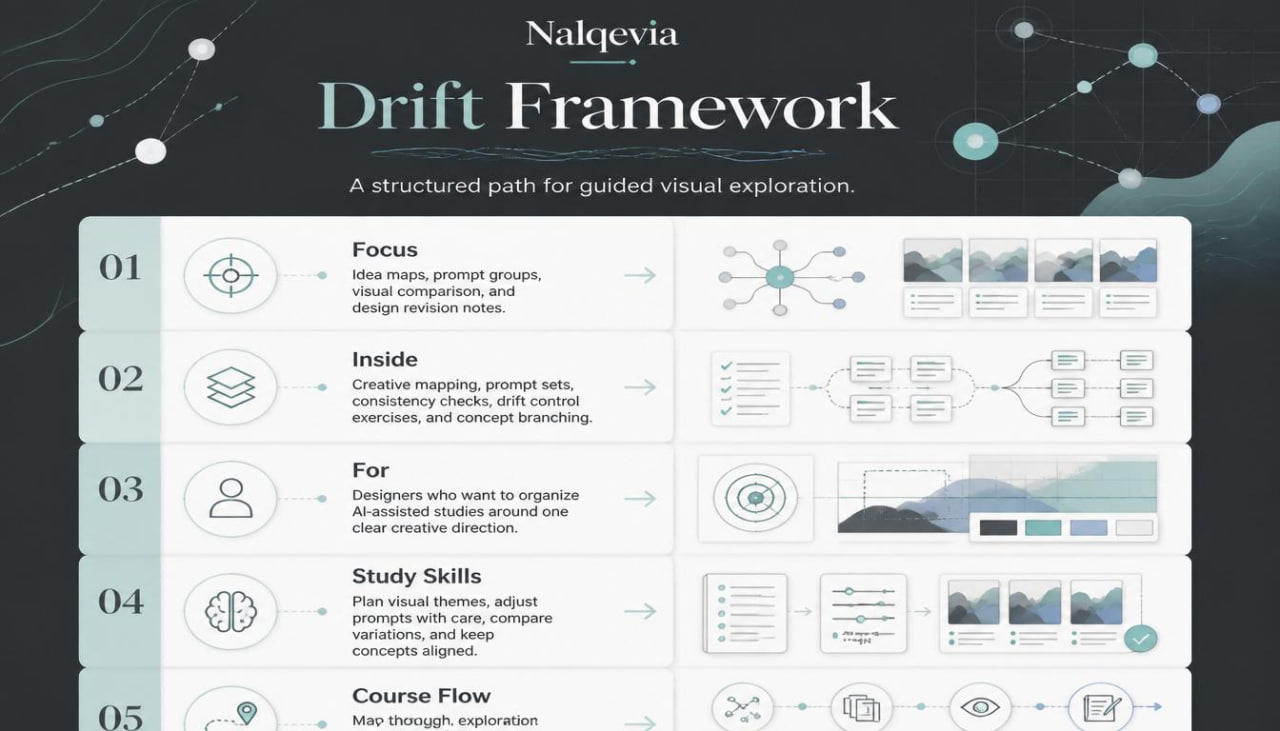
Drift Framework introduces a structured method for planning, writing, reviewing, and refining AI-assisted design studies. The course helps learners build a repeatable creative framework that connects brief writing, prompt groups, visual comparison, and revision notes. Instead of treating each prompt as a separate attempt, learners study how to create a connected sequence of design directions. The course also shows how to document choices, compare results, and refine visual language over several rounds. This gives designers a more thoughtful way to work with AI while keeping personal creative judgment at the center. -
What’s Inside
Drift Framework begins with a module on creative mapping. This section introduces a simple way to organize a design idea before writing any prompts. Learners study how to break one concept into smaller parts, such as subject, mood, color, shape language, composition, material feeling, lighting, and intended use. This map becomes the base for the rest of the course.
The next module focuses on building a visual direction board through written notes. Learners are guided to describe what they want to explore without naming specific programs or outside services. The material covers how to write reference notes for texture, atmosphere, spatial feeling, object style, brand mood, editorial tone, and abstract visual cues. This helps learners turn scattered ideas into a more readable creative plan.
A major part of the course is the prompt framework section. Here, learners study how to create groups of related prompts rather than isolated lines. The first group may describe the core visual concept. The second group may explore material and surface. The third group may shift composition, scale, or lighting. The fourth group may test visual mood while keeping the main idea intact. This approach helps learners understand how small changes can guide a design study without losing direction.
Drift Framework also includes a module on visual consistency. This section helps learners review AI-assisted outputs by looking at repeated elements, color relationships, spacing, texture behavior, object shape, and overall mood. The goal is to help learners identify which outputs belong to the same design family and which ones feel disconnected from the original brief.
Another section covers creative drift control. This module gives the course its name. Learners study how ideas can slowly move away from the first intention when prompts are changed too heavily. The material shows how to keep useful variation while still protecting the core creative direction. Learners practice rewriting prompts with small, purposeful adjustments instead of replacing the whole idea each time.
The course includes guided exercises for concept branching. In one task, learners begin with one design idea and create three branches: minimal editorial, tactile object study, and atmospheric abstract layout. Each branch keeps the same core concept but explores a different visual mood. This helps learners study variation without creating a disconnected set of results.
Drift Framework also includes a design review worksheet. This material gives learners a place to record which prompts were used, what visual results appeared, what worked, what felt misaligned, and what should change in the next round. The worksheet supports a slower, more intentional workflow and helps learners make better creative decisions over time.
A separate module focuses on revision language. Learners study how to write adjustment notes for lighting, spacing, scale, contrast, detail density, material texture, and composition. Instead of writing vague phrases, learners practice giving precise creative direction. This is useful when a visual result is close to the desired mood but needs refinement.
The course also includes a section on building a reusable design framework. Learners create a personal structure for future AI-assisted studies. This may include a brief format, a prompt group format, a review checklist, and a reflection note. The goal is to help learners create a stable study method they can adapt to different design themes.
Drift Framework closes with a guided concept study. Learners choose a fictional design theme and move through the full process: map the idea, write a brief, create prompt groups, compare results, revise wording, and document the final direction. This project ties the course together and helps learners practice the full framework in one organized flow.
-
Who Is This For?
Drift Framework is for designers who already understand basic prompt writing and want a more organized way to guide AI-assisted design studies. It is suitable for brand designers, visual creators, art direction learners, digital composition students, and anyone who wants to connect creative exploration with structured documentation.
This course is also useful for learners who often generate many visuals but struggle to decide which direction to continue. Drift Framework helps them build a review habit, compare results with more care, and keep design studies aligned with a written creative plan. It is made for people who enjoy visual exploration but want less noise and more direction in the process.
- What You’ll Learn
- How to create a creative map before writing prompts
- How to organize one design idea into mood, color, texture, and layout notes
- How to build connected prompt groups for AI-assisted design study
- How to explore variation while keeping the main concept stable
- How to review outputs for consistency, detail, spacing, and visual tone
- How to identify when a concept has drifted too far from the original brief
- How to write revision notes for light, scale, contrast, and composition
- How to compare several directions and choose which one needs further study
- How to document prompts, outputs, and creative decisions
- How to build a reusable framework for future design exercises
- How to create a small concept study from idea map to final review
- How to keep personal design judgment active throughout the process
-
30-Day Refund Note
Drift Framework includes a 30-day refund option under Nalqevia’s store terms. If the course does not match the learner’s study needs, a refund request may be sent through the contact page within 30 days of purchase. The request should include the order details and a short note about the reason for the request. Our team reviews each request according to the store policy and replies with the next steps.
Self-paced learning overview
- 🗂️ Digital file available after purchase
- ♾️ Long-term availability
- 🔐 Secure checkout
- 🗓️ Content updated in 2026
Do I need prior AI knowledge?
Do I need prior AI knowledge?
No prior AI knowledge is required. The materials are written with clear explanations, guided modules, and practical tasks so learners can move through the course with a calm study flow.
What do the courses include?
What do the courses include?
Each course may include modules, written materials, guided exercises, visual examples, creative prompts, and practice tasks shaped around design workflows.
Who are these courses created for?
Who are these courses created for?
They are created for designers, creative learners, brand-minded creators, visual thinkers, and anyone interested in studying how AI can support design research, concept building, and creative direction.
Share