Nalqevia
Cipher Layout
Cipher Layout
Couldn't load pickup availability
-
Problem Statement
Many AI-assisted visuals can look interesting at first glance, but the layout may still feel unclear or visually unstable. Designers may notice that objects compete for attention, text areas feel difficult to plan, spacing lacks rhythm, or the main idea becomes lost inside too many details. This can create friction when a learner wants to use AI-assisted exploration for brand concepts, editorial studies, presentation visuals, or campaign-style compositions. A strong visual mood is helpful, but without layout discipline the final direction may feel unfinished. Cipher Layout was created for learners who want to study how composition, hierarchy, and spacing can bring more order into AI-assisted design work. -
Solution
Cipher Layout gives learners a structured course path for understanding how layouts behave in AI-assisted visual exploration. The course introduces core design ideas such as balance, focal points, negative space, object placement, visual rhythm, scale, and compositional contrast. Learners study how to describe layout direction through written prompts and how to review visual results with a sharper design eye. The course also helps learners prepare layout notes before generating, so the visual direction has a stronger foundation. Each module connects prompt writing with design judgment, giving learners a practical way to guide composition instead of relying on random arrangement. -
What’s Inside
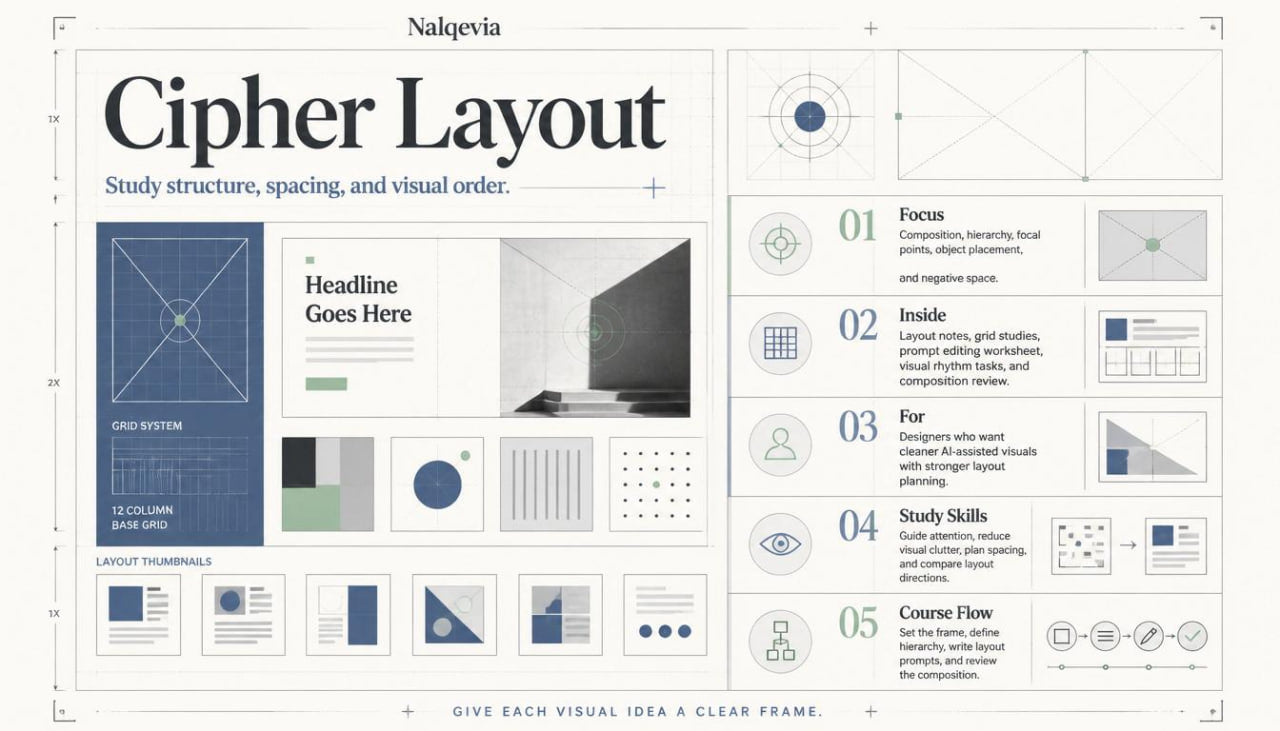
Cipher Layout begins with a module called “The Hidden Order of a Visual.” This opening section introduces the idea that every image has an internal structure, even when it appears loose or expressive. Learners study how the eye moves across a composition, how focal points are formed, and how spacing can create calm, tension, or visual movement. The goal is to help learners see layout as an active part of creative direction.
The next module focuses on hierarchy. Learners study how to define what should be seen first, second, and third inside a visual study. This includes subject scale, background depth, contrast, light placement, sharpness, object grouping, and empty space. The material shows how hierarchy can be written into a prompt through clear compositional language.
A dedicated section covers grid thinking without using rigid templates. Learners explore center alignment, modular spacing, asymmetrical balance, editorial columns, object clusters, and open margins. The course explains how to think in layout zones, even when the final image is abstract or atmospheric. This helps learners guide AI-assisted visuals toward more organized compositions.
Cipher Layout also includes a module on negative space. Learners study how open areas can make a design feel more refined, calm, or focused. The material explains how to describe spacious backgrounds, quiet margins, isolated objects, soft framing, and breathing room around the main subject. This section is useful for learners who want to avoid crowded visual results.
Another part of the course focuses on object placement. Learners practice describing where elements should sit inside a composition: centered, lower third, upper corner, diagonal path, layered foreground, distant background, or floating arrangement. The module also explores how object placement can create mood, direction, and visual narrative.
The course includes a visual rhythm section. Learners study repeated shapes, spacing intervals, line direction, curved movement, geometric contrast, and layered depth. This module helps learners understand how rhythm gives a layout a sense of flow without making it feel chaotic. Exercises invite learners to rewrite prompts with rhythm in mind.
A separate module introduces layout prompts for design concepts. Learners study examples written for editorial covers, brand mood visuals, abstract posters, object studies, and clean presentation frames. These examples are neutral and do not mention named programs or outside platforms. Each example is paired with notes explaining why the layout wording works.
Cipher Layout also includes a prompt editing worksheet. Learners take a loose prompt and improve it by adding clearer hierarchy, spacing, framing, and focal direction. The worksheet includes questions such as: What is the main subject? Where should attention begin? How much empty space is needed? What should stay quiet in the background? Which details should be reduced?
The course provides a composition review board for comparing outputs. Learners record whether the layout feels balanced, where the eye moves first, whether the subject is clear, how the background behaves, and whether spacing supports the intended mood. This review board helps learners make layout decisions with more care.
Another section focuses on reducing visual clutter. Learners study how to remove extra detail through prompt language. They practice using calmer descriptions, fewer competing objects, cleaner backgrounds, softer contrast, and more intentional focal points. This is especially useful when AI-assisted visuals become too dense or visually noisy.
Cipher Layout also includes a module on layout adaptation. Learners study how one creative idea can be arranged in different formats, such as centered composition, wide horizontal frame, vertical editorial frame, close crop, object grid, or spacious abstract scene. The point is not to copy a fixed format, but to understand how composition changes the reading of an idea.
The course closes with a guided layout study. Learners choose one fictional design theme and create a small set of layout directions around it. The study includes a composition brief, three prompt variations, review notes, layout comparison, and a final written reflection. This allows learners to connect the full course into one practical design exercise.
-
Who Is This For?
Cipher Layout is for designers who want more control over composition in AI-assisted creative work. It is suitable for brand designers, editorial learners, digital creators, art direction students, presentation designers, and visual thinkers who care about spacing, structure, and hierarchy.
This course is also useful for learners who often like the mood of an AI-assisted visual but feel that the arrangement needs better order. Cipher Layout helps them study how to guide attention, reduce clutter, and build cleaner visual structure. It is made for people who want their creative studies to feel more intentional, organized, and design-aware.
- What You’ll Learn
- How to describe composition with clearer layout language
- How to define focal points before writing a prompt
- How to guide hierarchy through scale, contrast, light, and placement
- How to use negative space as part of visual direction
- How to describe object placement inside a frame
- How to create calmer layouts with fewer competing details
- How to compare AI-assisted outputs through layout review notes
- How to identify visual clutter and refine prompt wording
- How to study rhythm through repeated shapes, spacing, and movement
- How to adapt one concept into several layout directions
- How to plan design visuals for brand, editorial, or concept studies
- How to connect prompt writing with composition judgment
-
30-Day Refund Note
Cipher Layout follows Nalqevia’s 30-day refund policy. If the course does not match the learner’s study needs, a refund request may be sent through the contact page within 30 days of purchase. The request should include order details and a short note about the reason for the request. Our team reviews each request according to the store terms and replies with the next steps.
Self-paced learning overview
- 🗂️ Digital file available after purchase
- ♾️ Long-term availability
- 🔐 Secure checkout
- 🗓️ Content updated in 2026
Do I need prior AI knowledge?
Do I need prior AI knowledge?
No prior AI knowledge is required. The materials are written with clear explanations, guided modules, and practical tasks so learners can move through the course with a calm study flow.
What do the courses include?
What do the courses include?
Each course may include modules, written materials, guided exercises, visual examples, creative prompts, and practice tasks shaped around design workflows.
Who are these courses created for?
Who are these courses created for?
They are created for designers, creative learners, brand-minded creators, visual thinkers, and anyone interested in studying how AI can support design research, concept building, and creative direction.
Share